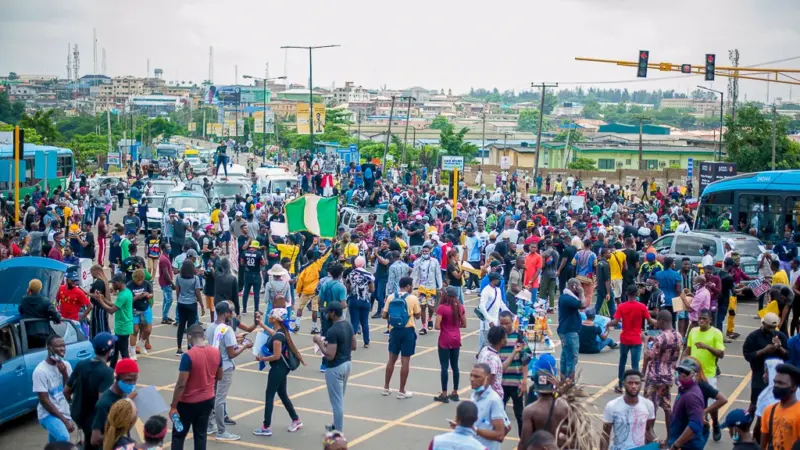
The #EndSARS demonstrations of October 2020 brought young Nigerians together around demands to end police brutality. A retrospective by Cali-Dibang Nshua examines what followed: some participants became more involved in public life, while others felt greater distrust or began imagining a future elsewhere. Its central point is that a shared experience did not produce a single, uniform response.
The movement showed how people could organise outside established party structures. Online networks helped participants exchange information, raise support and coordinate assistance. The retrospective describes that experience as an entry into political consciousness for some young Nigerians. Participation could change how a person understood citizenship even when it did not immediately deliver the institutional changes that person wanted.
The article discusses research connecting protest participation and later political engagement, but the distinction between association and guaranteed outcomes remains important. Greater interest in voting or standing for office is not the same as winning an election. Nor should the experience of a research sample be treated as a complete account of every young Nigerian's relationship with politics.
Disillusionment is another part of the account. A movement can encourage collective confidence while also leaving participants fearful or doubtful about whether institutions will respond. The retrospective considers both possibilities rather than presenting activism as an automatic route to lasting optimism. People may remain engaged, withdraw for a time or change the way they participate.
Migration makes the picture more complex. The article connects the discussion to 'japa', the widely used expression associated with leaving Nigeria, but explicitly rejects a simple claim that #EndSARS caused emigration. Work, education, insecurity, prices, infrastructure and personal ambitions can all shape decisions. Demonstrating a direct causal link would require more than observing that migration and political frustration occurred in the same period.
Leaving the country also does not necessarily mean leaving its public life. Someone abroad may continue following events, supporting causes or debating Nigeria's future. The retrospective's value is in holding these different paths together: mobilisation, disappointment, departure and continued participation can overlap. It is a reflection on the aftermath of 2020, not a report of a new protest or a claim that an entire generation thinks alike.