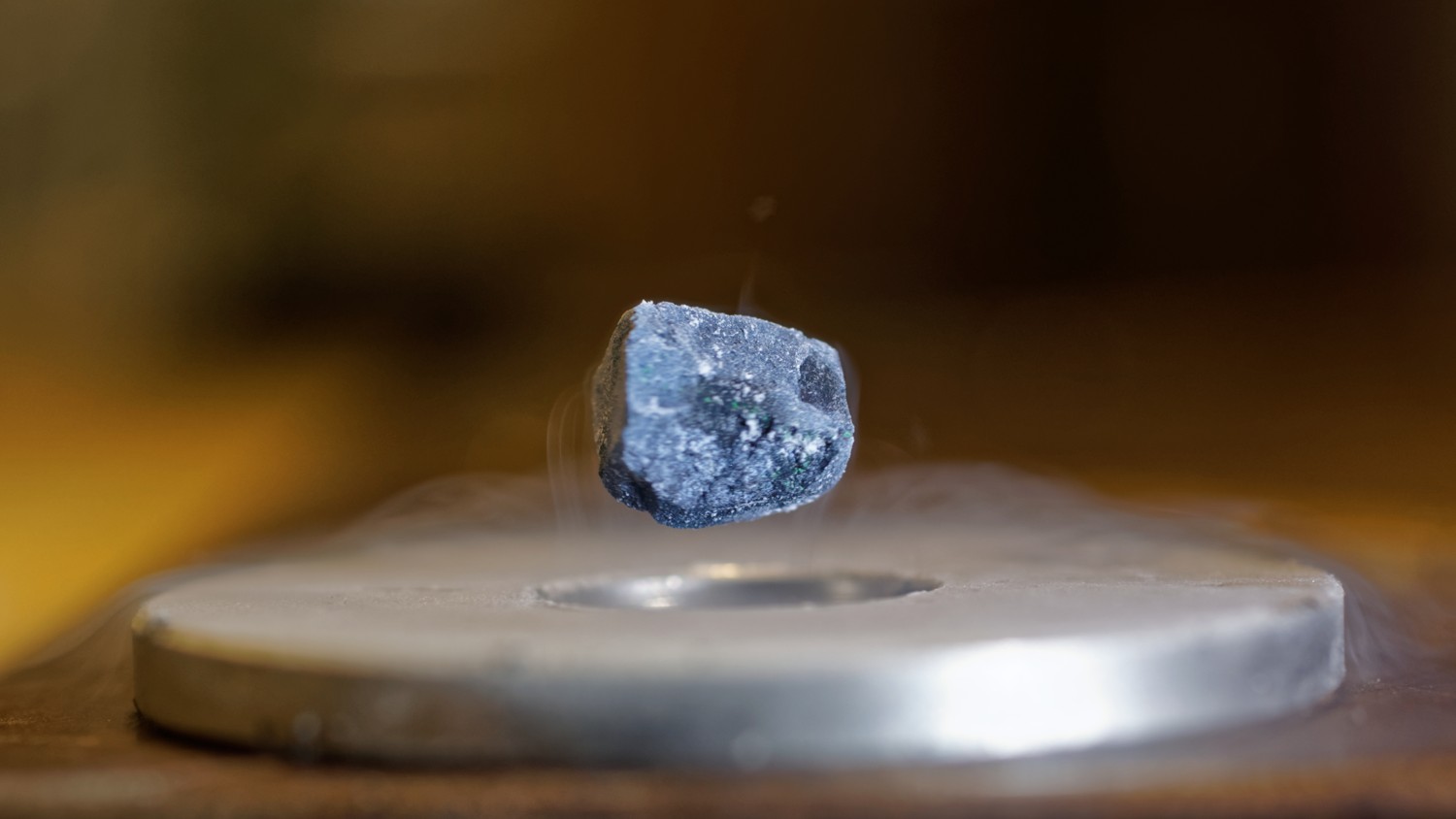
Researchers at Cornell University have reported evidence that two distinct forms of superconductivity can coexist in uranium ditelluride, a material being investigated for unusual quantum behaviour. The university’s 30 October 2026 account describes a laboratory advance, with an important limit: it does not claim that the team has conclusively demonstrated the sought-after topological superconductor. That remains a research goal.
Superconductivity allows certain materials to carry direct electric current without electrical resistance when the necessary conditions are met. The US Department of Energy explains that such behaviour usually requires cooling below a critical temperature. Different superconducting states involve different behaviour of paired electrons. In this study, the question was whether two states in the same compound could exist together, rather than simply replace one another under different conditions.
The Cornell team used precise ultrasound measurements and strong pressure to examine the material as it was cooled to between one and two kelvin, an extremely low temperature range. The researchers rebuilt its phase diagram: a map showing which state occurs under particular combinations of conditions. According to the university, the resulting map includes a region where the two superconducting states coexist and interact.
The interaction also produced an unusual result. One state disappeared as the sample became colder because the competing state displaced it. This contrasts with the usual expectation that cooling supports superconductivity. The finding concerns the behaviour of this particular material under the experimental conditions. It should not be turned into a general claim that all superconductors stop working when cooled further.
The paper appeared in Nature Physics on 30 October, with doctoral researcher Sahas Kamat as first author and physicist Brad Ramshaw as corresponding author. Ramshaw says a possible quantum-computing use remains several steps away. For Nigerian students and technology readers, the distinction is between identifying promising material behaviour and delivering usable computing equipment. The announcement reports no commercial computer, room-temperature operation or Nigerian deployment.
The next challenge is to determine whether the observed ingredients actually produce the desired topological state and, beyond that, whether it can support useful technology. Those steps require further evidence. The verified result is narrower but still significant: the experiment provides a clearer account of how two superconducting states share and compete within one material, helping researchers decide what to test next.