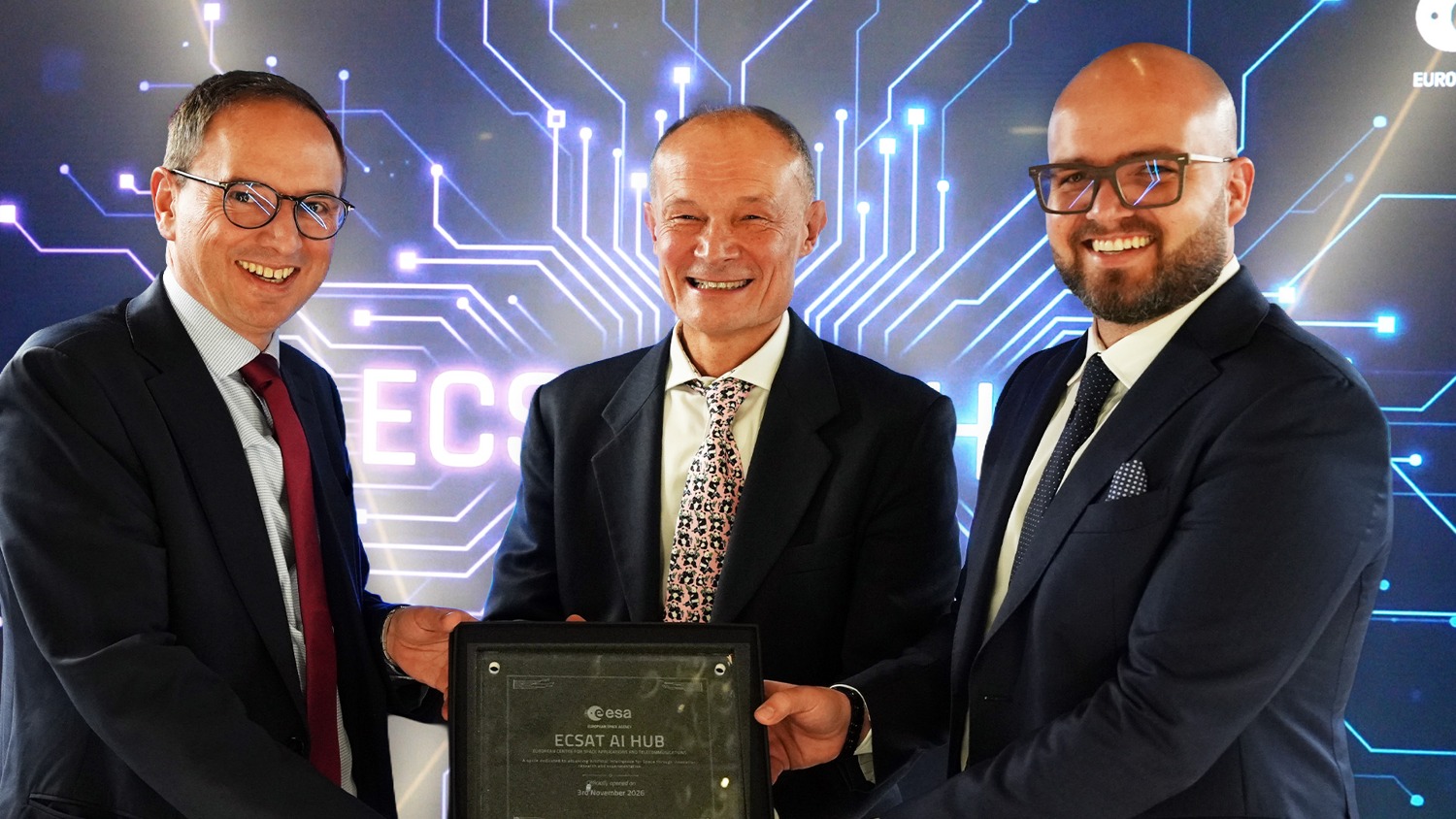
The European Space Agency opened a laboratory at Harwell in the United Kingdom on 3 November to investigate how artificial intelligence might help run communications networks that include satellites. The first project brings together the company Autodiscovery and the Oxford Robotics Institute. They will explore how a four-legged robot and a scouting drone can operate using such connections.
The building is on the ground, at ESA’s European Centre for Space Applications and Telecommunications. Its equipment includes computers, robotic and drone platforms, technical labs and space for demonstrations. The agency intends it as a place for companies and researchers to develop and test ideas before those ideas become services that people rely on.
One question is how networks can make better use of radio frequencies. Different users need a share of that limited resource. ESA wants to examine whether systems can respond automatically when demand or conditions change. Another line of work concerns cybersecurity as more parts of a network have to communicate with one another.
The team also plans to investigate networks using satellites in different orbits. One proposed approach is a digital twin, a computer representation of a network. Researchers could change conditions in the model and observe the consequences for performance, without having to impose those changes on a working service.
The new facility will have access to the network and equipment at the site's existing 5G and 6G hub, which opened in 2022. That earlier hub has a private satellite network. Direct links to devices and work on future mobile networks are among the research topics ESA identifies for the new facility.
What it means for you. For a Nigerian reader following satellite broadband, the useful detail in the announcement is what can now be tested. A robot and drone using a research network in Britain do not establish what speeds a phone in Nigeria will receive. ESA’s notice announces a lab and a first project. It gives no Nigerian retail price or service launch date.