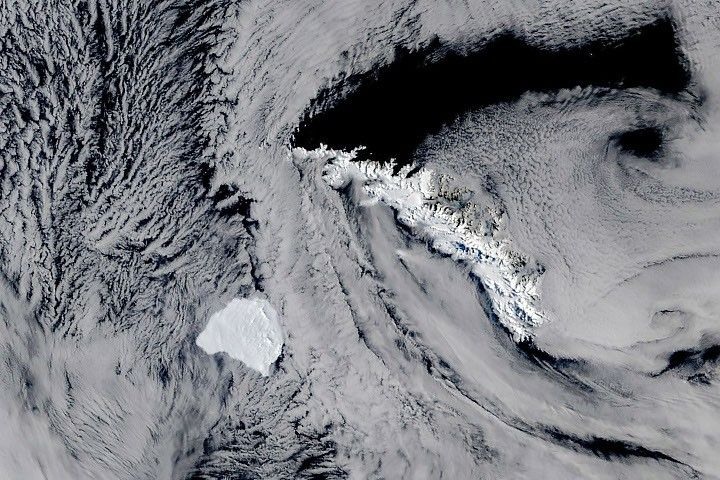
Iceberg A-81 has travelled from Antarctica toward South Georgia, where shallow seafloor features appear to be slowing its movement. NASA Earth Observatory reported the development on October 27, using a Terra satellite image taken a week earlier. The observation follows the iceberg's progress rather than announcing a fresh break from Antarctica.
A-81 separated from the Brunt Ice Shelf in January 2023. At the time it covered roughly 1,550 square kilometres. After spending more than three years moving through the Weddell Sea, it reached the Antarctic Peninsula's northern end in May 2026 and continued into the Scotia Sea toward the South Atlantic island.
By late October, the iceberg was near South Georgia, far from the ice shelf that produced it. Specialists cited by NASA observed that its movement had slowed and that it appeared to be encountering the island's underwater shelf. A satellite image can reveal location and shape, while a sequence of observations is needed to interpret motion.
The underwater landscape matters because much of an iceberg lies below the surface. A shallow shelf can interrupt a journey that looks unobstructed when viewed only from above. South Georgia has previously delayed other large bergs, including A-23A, which grounded in 2025 and later broke apart.
A-81's creation was itself a long process. A major crack in the Brunt Ice Shelf remained relatively stable for decades before growing again, yet the final separation still took years. Calving is part of an ice shelf's normal behaviour, so a single break should not automatically be treated as proof of one particular cause.
Scientists continue to monitor Brunt and its departing icebergs because the shelf has produced several large pieces and supports an important research station. For A-81, the immediate question is how its changing shape, surrounding currents and the seabed will influence the next stage of its journey. The October image captures a moment in that ongoing story.