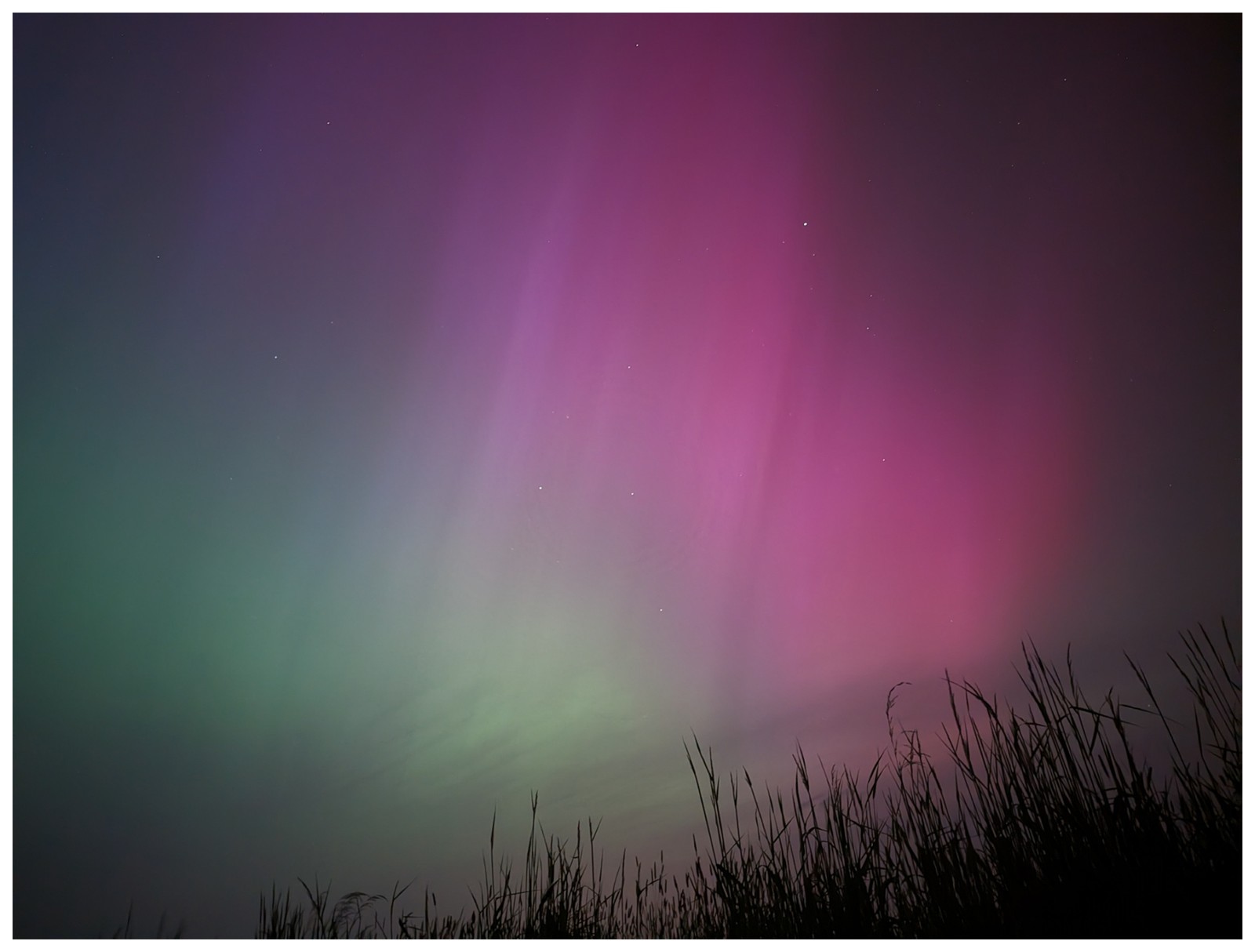
Photographs taken during a powerful solar storm in May 2024 have given researchers a new clue about why some auroras glow red. A study published in Annales Geophysicae on 3 November 2026 examines images from Braunschweig and Göttingen in Germany. The new development is the published analysis, not a new storm or a sighting over Nigeria.
The team noticed bright rays running from the higher red glow into the green aurora below. That continuous structure matters because it connects two colours that researchers might otherwise study separately. By comparing the pictures with measurements of solar-wind and geomagnetic conditions, the authors concluded that energetic electrons travelling along Earth’s magnetic field lines were the main cause of both sets of rays in this event.
This is an interpretation of observations, with an important limit. The paper says there were no direct measurements of the particles causing these red auroras during the storm. Photographs provide indirect evidence that can help distinguish between proposed explanations. The result does not establish that every red aurora, in every storm, must arise in exactly the same way.
The photographs also show why timing and camera settings can matter in research. A long exposure can blur a changing pattern into a smooth glow. The researchers’ public appeal asks photographers to use exposures no longer than six seconds when recording future auroras, so that narrow rays remain visible. The study’s Braunschweig photograph was taken by Philipp Schulz at 22:16 UTC on 10 May 2024.
The work brings together researchers from several countries and illustrates a practical role for citizen science: careful observations made outside a laboratory can become evidence for a scientific question. That does not mean every striking sky picture proves a discovery. Its place, date, direction and recording conditions help researchers decide what an image can reliably show.
What it means for you. For Nigerian students and photography clubs, the useful lesson is about documenting an observation before sharing an explanation. Keep the original file and record when and where it was taken. This report is not an aurora forecast for Nigeria and does not claim that the German observations occurred here. The photograph accompanying it is labelled with its actual location and 2024 date.