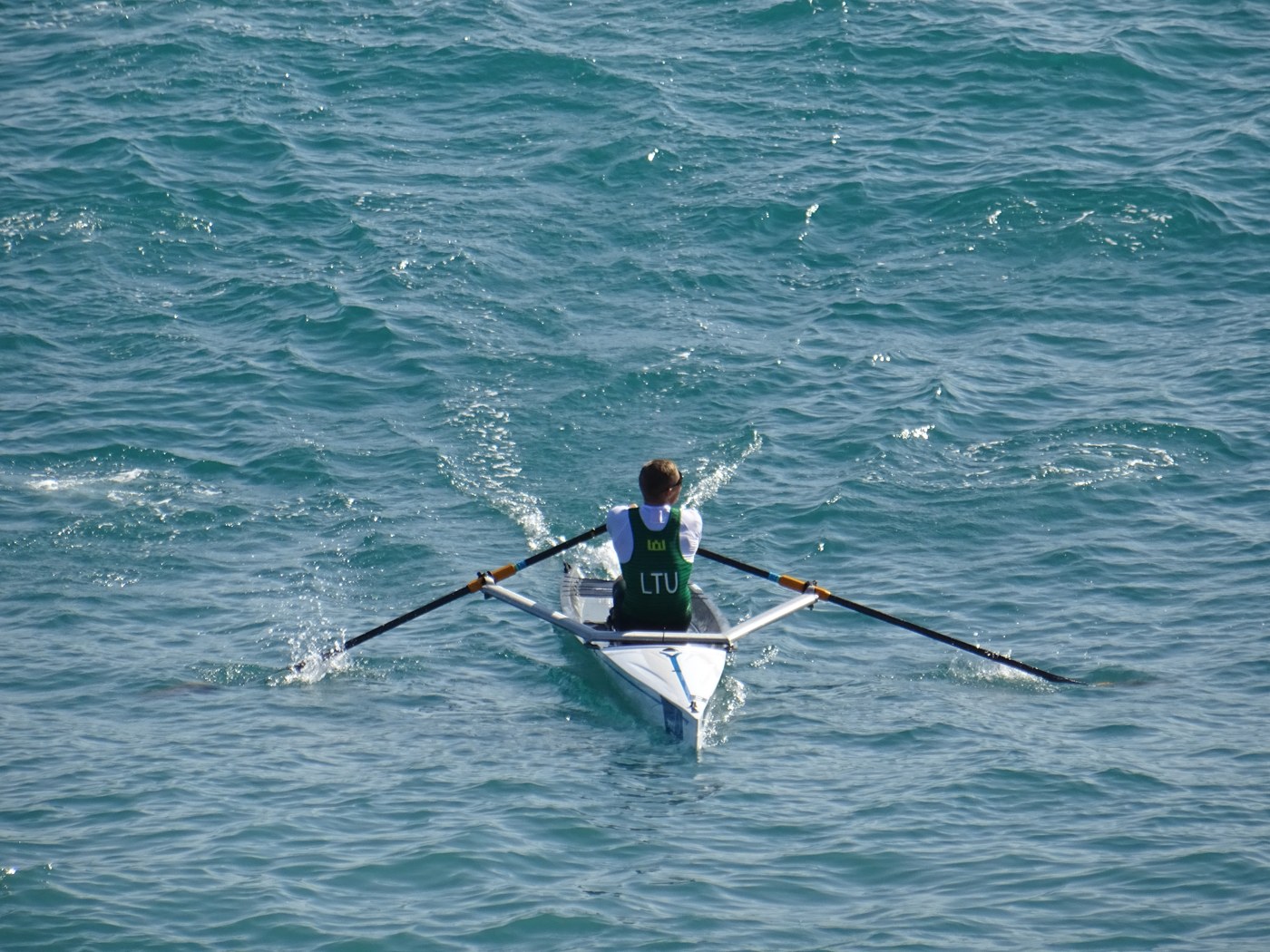
Callum Dreyer’s closest race on the way to gold came two rounds before the final. At Saly in Senegal, the South African beat Ondrej Zizka of Czechia by 0.14 seconds in their quarter-final. On Tuesday, 3 November, he finished the day as the first men’s solo champion in coastal rowing beach sprints at a Youth Olympic Games.
The route to the title required a series of wins over individual opponents. In the last 16, Dreyer beat Lithuania’s Justas Domarkas, using the waves on the way back to the beach. In the quarter-final his time was 2 minutes 24.52 seconds. Zizka finished in 2:24.66. A margin smaller than two tenths of a second kept Dreyer in the competition.
Next came Hungary’s Adam Moor. Dreyer won their semi-final in 2:29.35, setting up a gold-medal race against Diego Molina Martinez of Spain. Dreyer posted 2:15.65 in the final, while Molina Martinez finished in 2:44.39. Moor won the separate race for bronze against Egypt’s Yossuf Moursi.
Anyone used to watching flat-water rowing will recognise the oars but may be surprised to see the competitors running. In the beach sprint format the athletes start on sand, reach their boats and row out through a slalom. A 180-degree turn around a buoy sends them back towards shore. They have to leave the boat and sprint to finish.
That sequence helps explain why a head-to-head result matters more than comparing times from different rounds. Dreyer’s semi-final took longer than his quarter-final, but he had beaten the opponent in front of him, which was what he needed to progress. His faster time against Molina Martinez earned him the title.
This was the first Youth Olympic appearance for the discipline. China had already won the mixed double on Monday and Liu Lili took the women’s solo gold on Tuesday. The South African’s first belongs specifically to the men’s solo event. It is a Youth Olympic gold medal, and his final time is the result of that race rather than a claim to a world speed record.