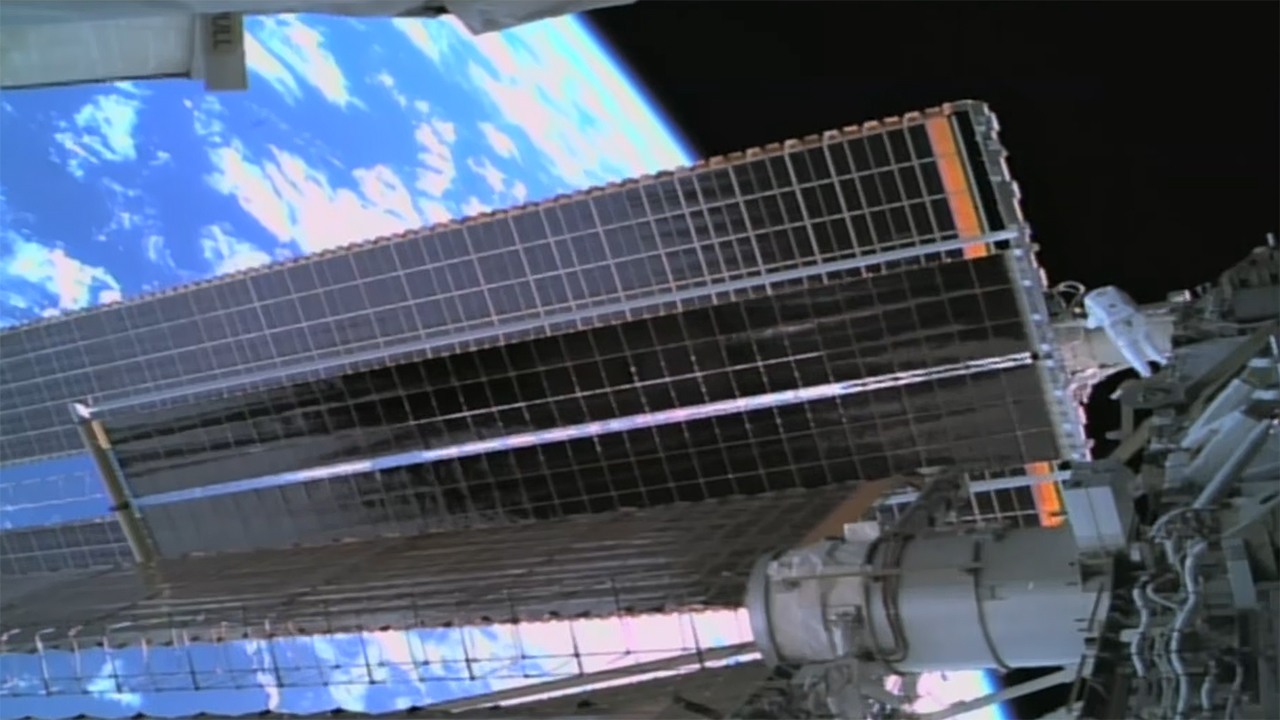
The International Space Station has completed a solar-power upgrade that began more than five years ago. On 5 November, NASA astronaut Anil Menon and Canadian Space Agency astronaut Joshua Kutryk installed and deployed the eighth and final roll-out solar array. Both agencies reported the completed work after the spacewalk, confirming that the previously scheduled installation had taken place.
The two astronauts spent six hours and 59 minutes outside the station, finishing at 3:35 p.m. US Eastern Standard Time. The last array was fitted to the 3B power channel on the station’s starboard truss. NASA says the campaign, begun in February 2021, required 18 spacewalks to prepare equipment and install all eight arrays.
Together, the arrays raise the station’s power-generation capacity from 160 kilowatts to approximately 215 kilowatts, NASA reports. That is an increase of about 55 kilowatts. These figures describe electrical power capacity, not an amount of energy delivered over a day. The final installation completes this particular expansion; it does not mean every part of station maintenance has ended.
The work also depended on colleagues inside the station and on Earth. The Canadian agency says NASA astronauts Luke Delaney and Jessica Watkins operated Canadarm2 to assist the spacewalkers. Canadian astronaut Jenni Gibbons handled communications as capcom at Johnson Space Center, while robotics teams in Houston and Longueuil monitored the arm and its manoeuvres.
The Canadian agency links the additional power to more scientific research and broader operating capabilities aboard the station. It also says experience with the technology can inform solar systems for future missions. That is a potential future use of the engineering knowledge, distinct from the hardware installation confirmed on Thursday. Kutryk’s earlier spacewalk with Menon was on 29 October.
What it means for you. For Nigerian readers following solar technology, this is a clear example of the difference between a promised upgrade and completed engineering work. The gain serves an orbiting research station; it is not electricity being supplied to Nigerian homes. Its practical lesson is that generating capacity, installation and the work that power can support are related but different measures of progress.