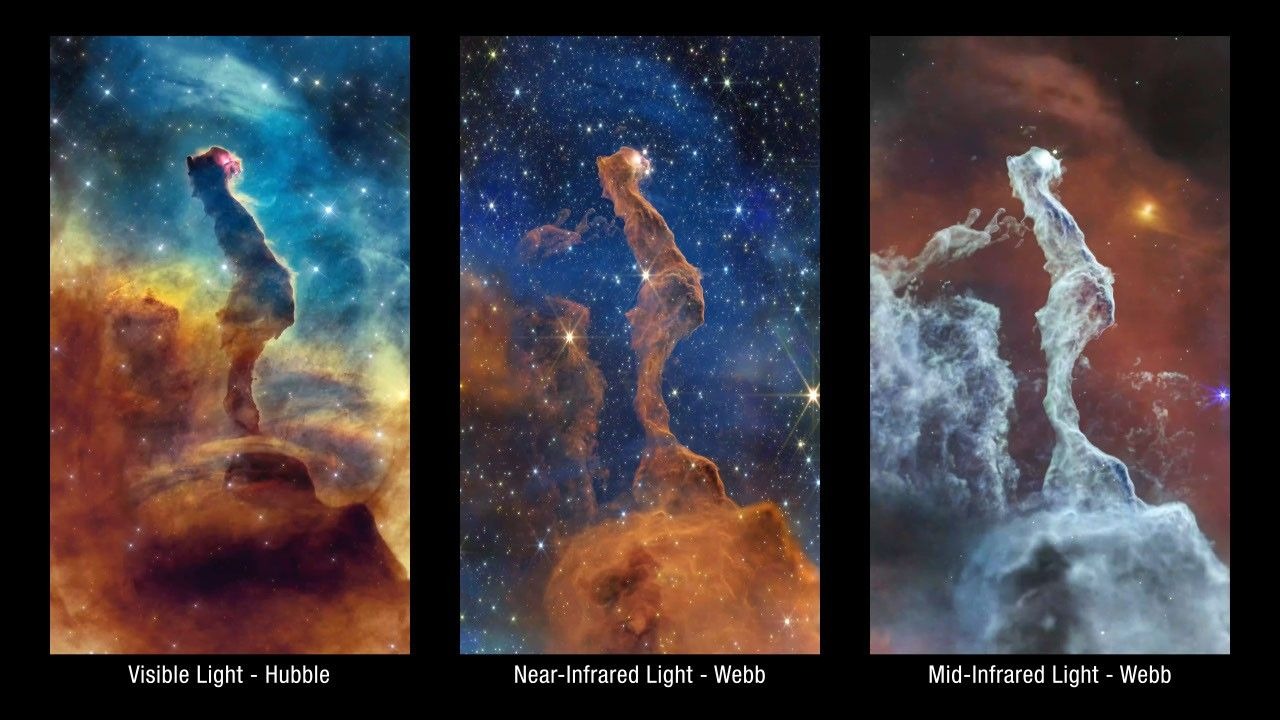
A dark pillar nicknamed the Cat's Head Nebula looks very different when telescopes observe it at different wavelengths. NASA's October 29 release compares Hubble and Webb views of this small region within the much larger Carina Nebula, about 7,500 light-years away.
The animal-like outline is a visual resemblance, not a separate kind of astronomical object. Radiation and winds from massive nearby stars have probably helped sculpt the gas and dust. Dense material resists erosion longer than its surroundings, producing a temporary shape.
Hubble's visible-light view shows an opaque dust pillar with a bright rim. The surrounding colours trace glowing gas and scattered starlight. A bright feature resembling an eye may be a young star still partly hidden inside the dusty material.
Webb's near-infrared observations reveal more internal detail and many stars that are less apparent in visible light. Its mid-infrared view highlights warm dust and molecules excited by starlight. Combining them gives researchers complementary information, rather than three interchangeable photographs.
Some apparent alignments remain uncertain. A narrow feature seems to cross a bright source, but the image alone cannot prove that they are physically connected. Likewise, the possible young star should retain that qualification until further evidence establishes its nature.
The scientific value extends beyond the memorable nickname. By comparing what each wavelength reveals or hides, astronomers can investigate how stars form and reshape their surroundings. The pillar will change over time, while the observations preserve evidence of one stage in that process.