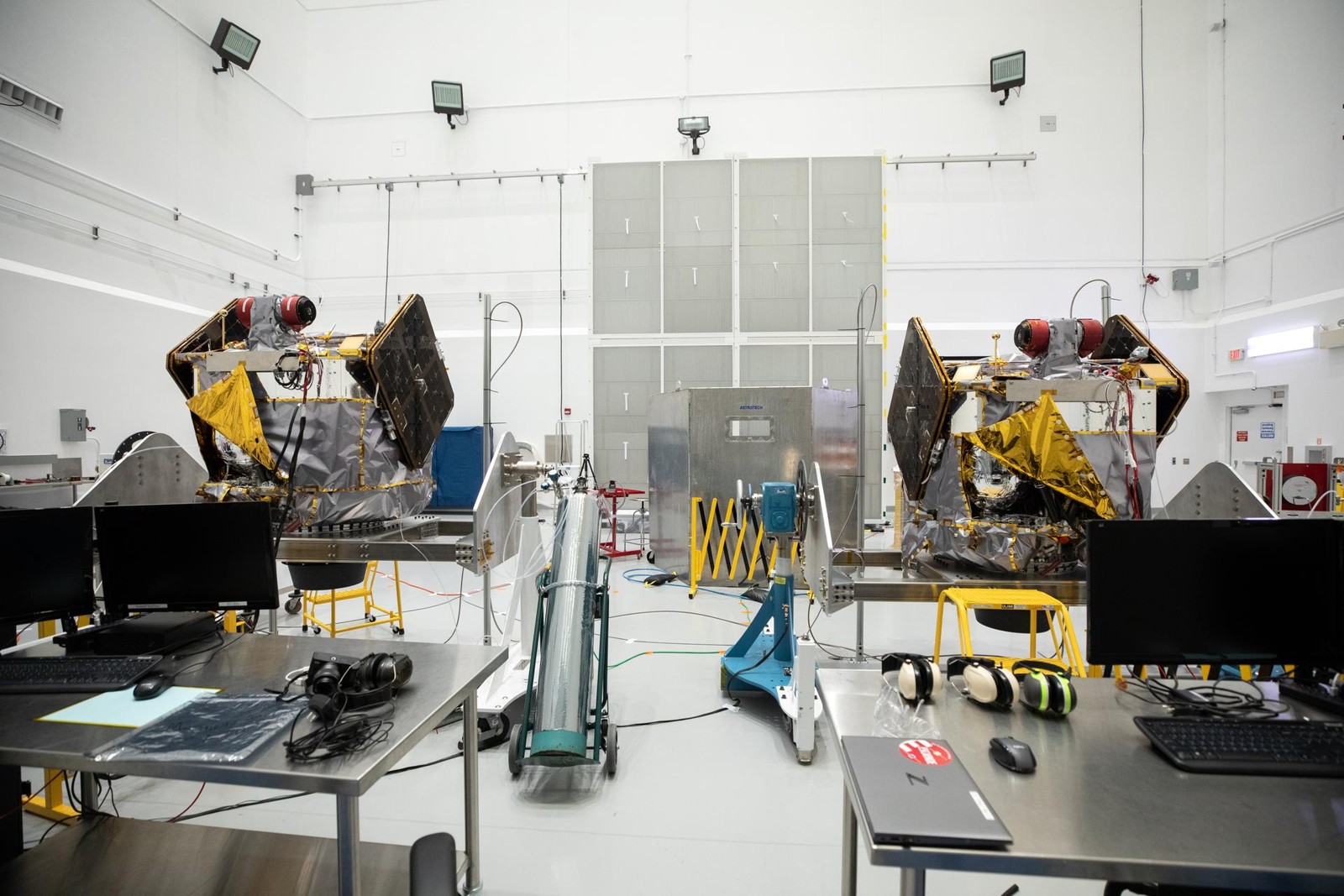
NASA has set out the next major step for its twin ESCAPADE spacecraft: two close passes of Earth, each combined with an engine firing, to put them on course for Mars. The first powered flyby is planned for 7 November and the second for 9 November. These manoeuvres remain ahead; the agency has not announced that either spacecraft has completed them.
According to NASA’s 2 November mission update, each spacecraft will fire its engine for about nine minutes near its closest approach. Earth’s gravity will change its direction and speed, while the engine supplies an additional push. The agency expects the two spacecraft to reach Mars on 7 and 9 September 2027. Those are mission targets, not completed arrivals.
ESCAPADE launched on 13 November 2025 but did not travel straight to Mars. The spacecraft followed a looping route around the Earth–Sun Lagrange point 2, a region beyond Earth in the direction away from the Sun. That route brought them back towards Earth as the planets reached a useful alignment for the next stage of the journey.
The mission is designed to examine how the solar wind interacts with Mars’ magnetic environment and contributes to the loss of its atmosphere. Two spacecraft can compare measurements from different places or times. The project seeks evidence about the planet’s changing environment; it is not carrying people or announcing that Mars has become suitable for human settlement.
After the flybys, controllers will need several days to assess how accurately the spacecraft are aimed. Further engine manoeuvres are planned to refine their paths. NASA also says the flight through a distant part of Earth’s magnetic tail produced observations that scientists intend to share. That promise should not be mistaken for a published discovery already available for independent assessment.
What it means for you. Nigerian students following planetary science can use these dates to track a mission through separate, testable stages: departure, navigation, arrival and research. A successful launch does not guarantee a successful journey. NASA’s notice discusses telescope viewing from particular overseas locations, but does not establish visibility from Nigeria. Follow mission updates for confirmation of the flybys rather than treating the schedule as proof that they happened.