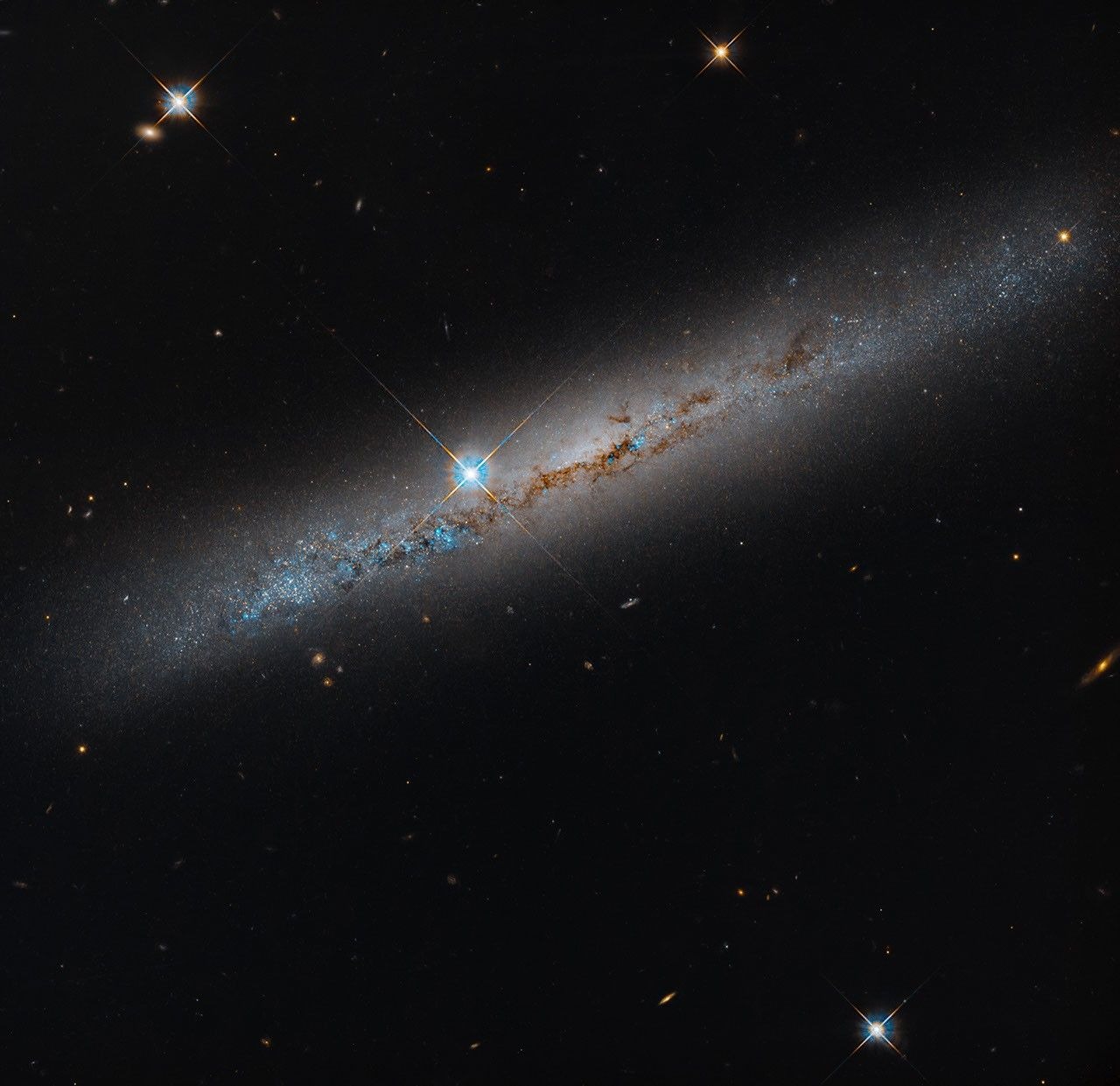
A Hubble image released on October 16 presents spiral galaxy NGC 1827 almost edge-on. Located about 37 million light-years away in the direction of Columba, it appears as an elongated strip of light rather than the familiar face-on spiral with clearly separated arms.
That viewing angle is central to the picture. We are looking through the galaxy's flattened stellar disc, where overlapping structures make a different pattern from an overhead view. Dark dust lanes interrupt the light, and a brighter central region marks the galaxy's bulge.
Blue, luminous patches along the disc likely trace regions where stars are forming. They do not turn the image into a complete census of young stars: the visible pattern also depends on the filters used, intervening dust and the geometry of the scene.
One especially bright object near the central bulge belongs to the foreground rather than NGC 1827. Its four spikes are an optical effect caused by structures supporting Hubble's secondary mirror. The star itself does not possess four long, luminous arms.
The observation forms part of work examining small satellite galaxies around larger, Milky Way-like hosts. NASA describes a programme involving 260 satellites around 22 host galaxies. Such surveys help researchers compare observed small galaxies with predictions from models of cosmic structure.
NGC 1827 therefore offers both a striking portrait and a lesson in interpretation. Apparent proximity in a photograph does not prove physical association, while a galaxy's orientation can hide its overall form. Instruments and context are needed to turn a beautiful scene into a reliable account.