Aït-Ben-Haddou entered UNESCO's World Heritage List in 1987 as an example of southern Moroccan earthen architecture. The fortified settlement stands in the Ounila Valley, on the southern foothills of the High Atlas in Ouarzazate Province. This is historical background to the place, rather than a new designation.
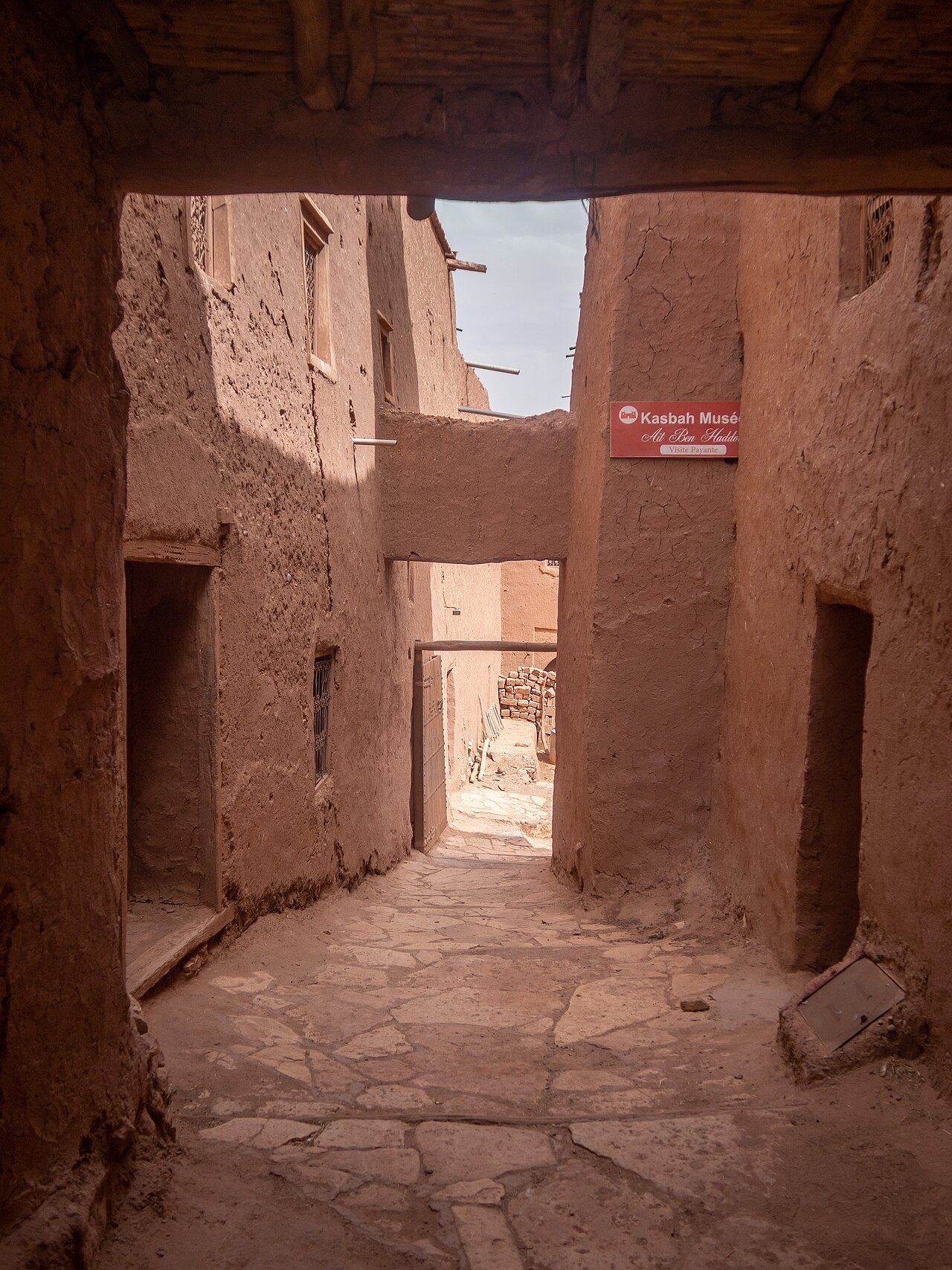
A ksar is a collective settlement, not simply one grand residence. At Aït-Ben-Haddou, defensive walls and corner towers enclose tightly grouped houses. Some dwellings are modest, while larger ones have high towers and decorative patterns made in clay brick. The contrast belongs to the settlement's social and architectural fabric.
Shared spaces are equally important to reading the site. UNESCO lists a mosque, public square, caravanserai, fortification and grain-storage building, with threshing areas outside the walls. Muslim and Jewish cemeteries and the sanctuary of Sidi Ali or Amer add further layers to its history.
The settlement was a trading post on a route linking the historic Sudan region with Marrakesh through the Dra Valley and Tizi-n'Telouet Pass. Here, Sudan refers to the historical trading region named in UNESCO's account. The route helps explain the importance of accommodation, storage and collective protection.
UNESCO says the oldest surviving constructions do not appear earlier than the seventeenth century, although their techniques have older regional roots. Earth and wood are central materials. Its conservation account, explicitly dated 2009, stresses that this architecture depends on regular upkeep; it should not be read as a fresh condition survey.
For a visitor, the useful perspective is to look beyond the outline of towers to the relationships between homes, lanes and communal buildings. The site's heritage value lies in that connected settlement. Its 1987 recognition celebrates a building tradition and way of organising space, not merely a picturesque backdrop.