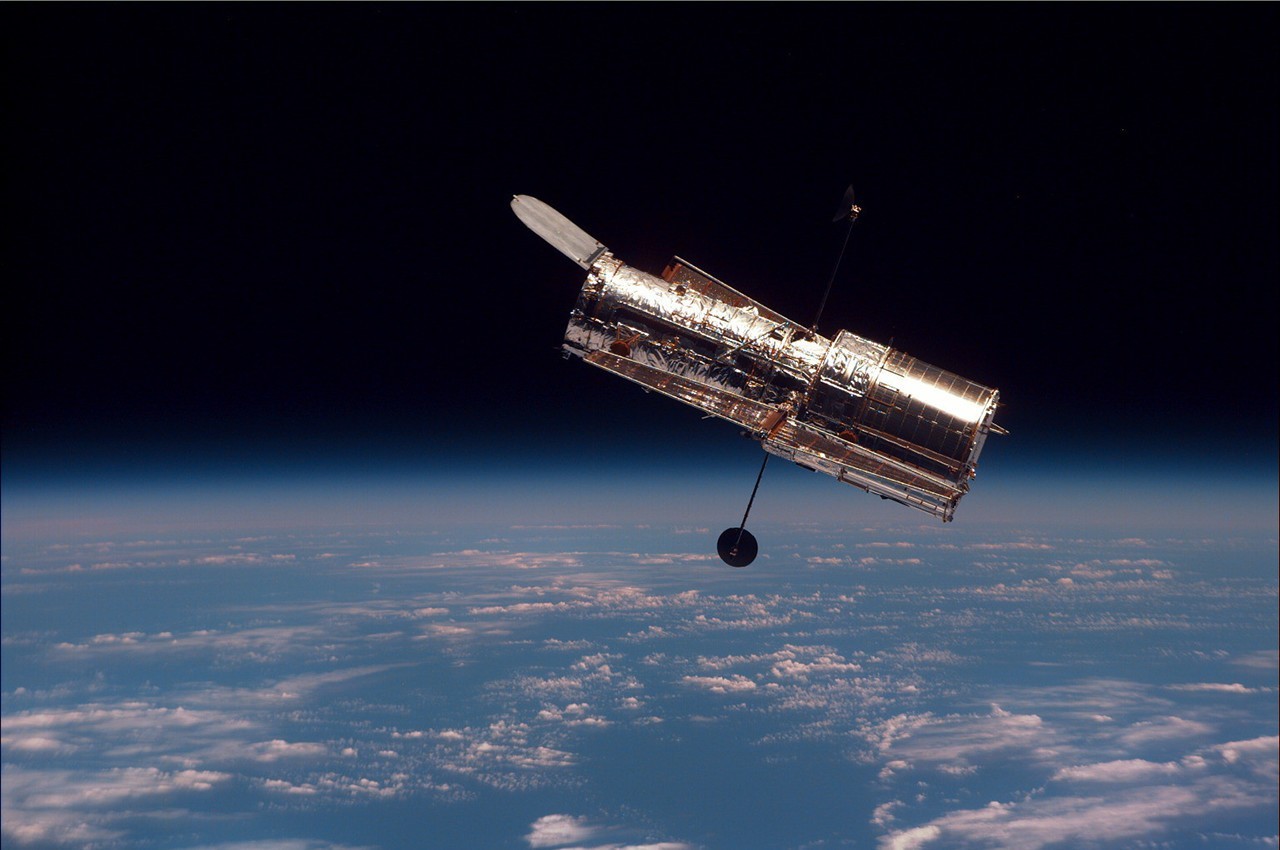
NASA is seeking information from commercial companies about ways to support the Hubble Space Telescope as it ages. In an announcement published on 30 October 2026, the agency said it had issued the request the previous day. The step is an examination of industry capabilities and interest. It does not announce a selected contractor, an approved servicing mission or a launch date.
The request covers three broad possibilities: raising Hubble to a higher orbit to extend its scientific life, servicing the telescope to improve its capabilities, and managing its eventual end through controlled atmospheric re-entry or orbital disposal. These are options under consideration, not three operations that NASA has committed to perform. Any later mission decision would need to be distinguished from this initial information-gathering stage.
The reason for planning ahead is physical. Atmospheric drag gradually lowers the altitude of spacecraft in low Earth orbit, and Hubble has no propulsion system with which to maintain its own orbit. NASA says analysis currently points to re-entry in the 2033–2034 period. That is a projection, not a fixed date or a report of an immediate threat. The agency anticipates that an intervention would need to happen by 2032.
Companies have until 3 p.m. Eastern Standard Time on 30 November to respond, according to the announcement. That is 9 p.m. in Nigeria, which is six hours ahead of that time zone. The deadline is for information submitted to NASA; it is not a date when astronauts or a robotic spacecraft will travel to Hubble. Readers should keep those two kinds of milestone separate.
Hubble remains a joint project of NASA and the European Space Agency. NASA’s Goddard Space Flight Center manages the telescope and mission operations, while the Space Telescope Science Institute carries out science operations. For Nigerian astronomy readers, the significance is the prospect of keeping an established observatory producing discoveries, alongside planning responsibly for the end of its operation. No additional years of service have yet been secured by this request.
The next evidence to watch is whether NASA moves from collecting ideas to choosing a specific approach. A proposed capability, a funded agreement and a completed servicing flight are different things. For now, the verified development is that NASA has invited industry responses while setting out the orbital decline and planning horizon that make the exercise necessary.