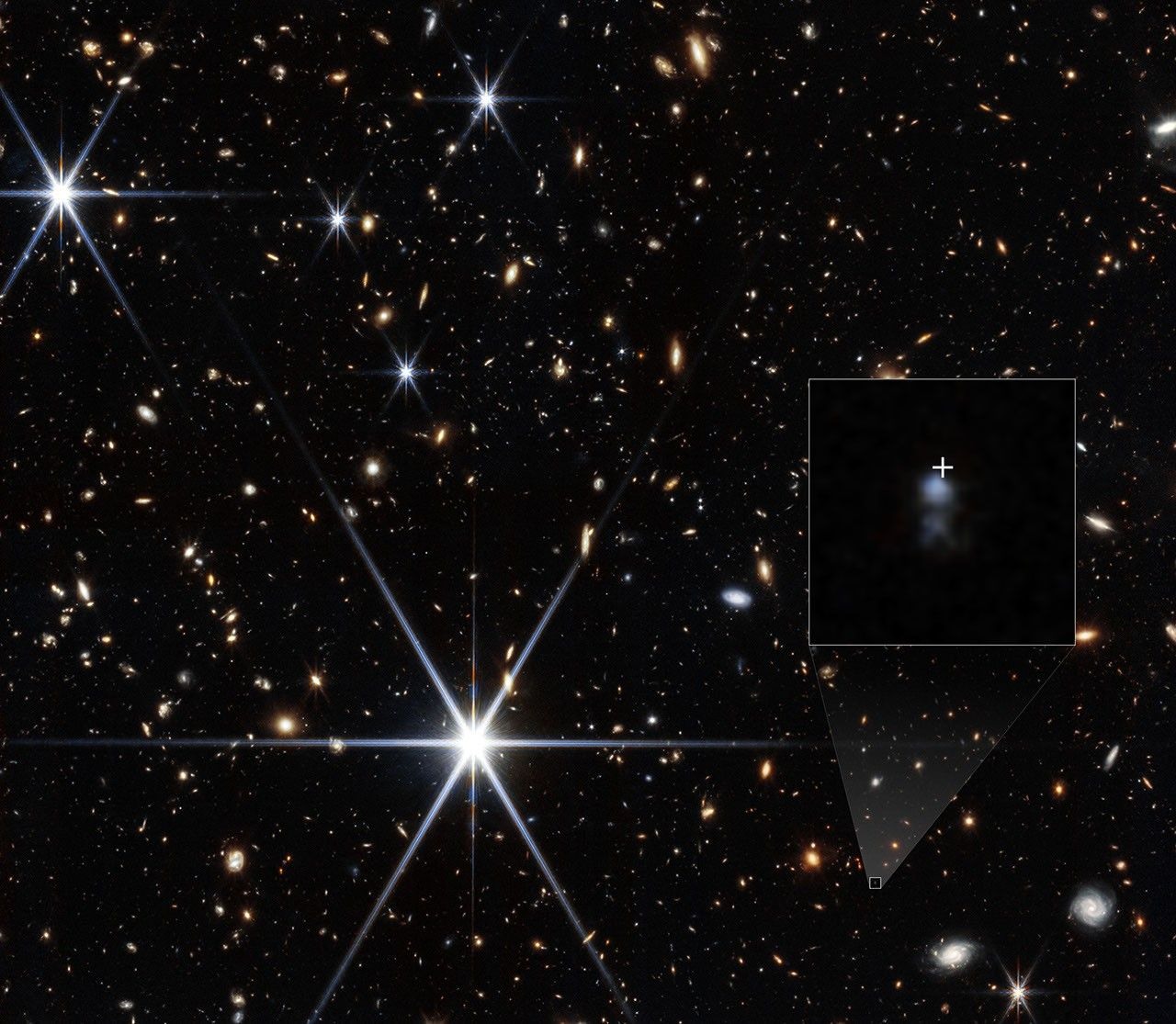
Astronomers using the James Webb Space Telescope have identified the host galaxy of an exceptionally distant fast radio burst. NASA's October 8 account describes FRB 20240304B, first detected with South Africa's MeerKAT radio telescope in March 2024. Webb supplied information that the original radio detection could not provide alone.
Fast radio bursts are brief flashes lasting milliseconds. Finding one does not automatically reveal the object that produced it. The team knew where this burst occurred, but ground-based observations could not identify a galaxy at the position, prompting the request for Webb observations.
Webb detected a small galaxy and measured its redshift, the stretching of light associated with cosmic expansion. The result places the event when the universe was about three billion years old. The host is much smaller than researchers expected and is actively forming stars.
That youthful environment matters when comparing possible sources. A mechanism requiring an extremely long delay is harder to reconcile with a population dominated by young stars. The researchers therefore argue that a merger of two neutron stars is unlikely to explain this particular burst.
A young, strongly magnetic neutron star, called a magnetar, is another candidate. The observations are consistent with that broad possibility, but they are not a direct photograph of a magnetar causing the flash. They also do not establish a single explanation for every known fast radio burst.
The result shows the value of combining radio detection with infrared observations. Future discoveries can test whether other distant bursts inhabit similar galaxies. For now, the advance is a measured distance and a clearer environment for one fleeting event, with the precise physical mechanism still under investigation.