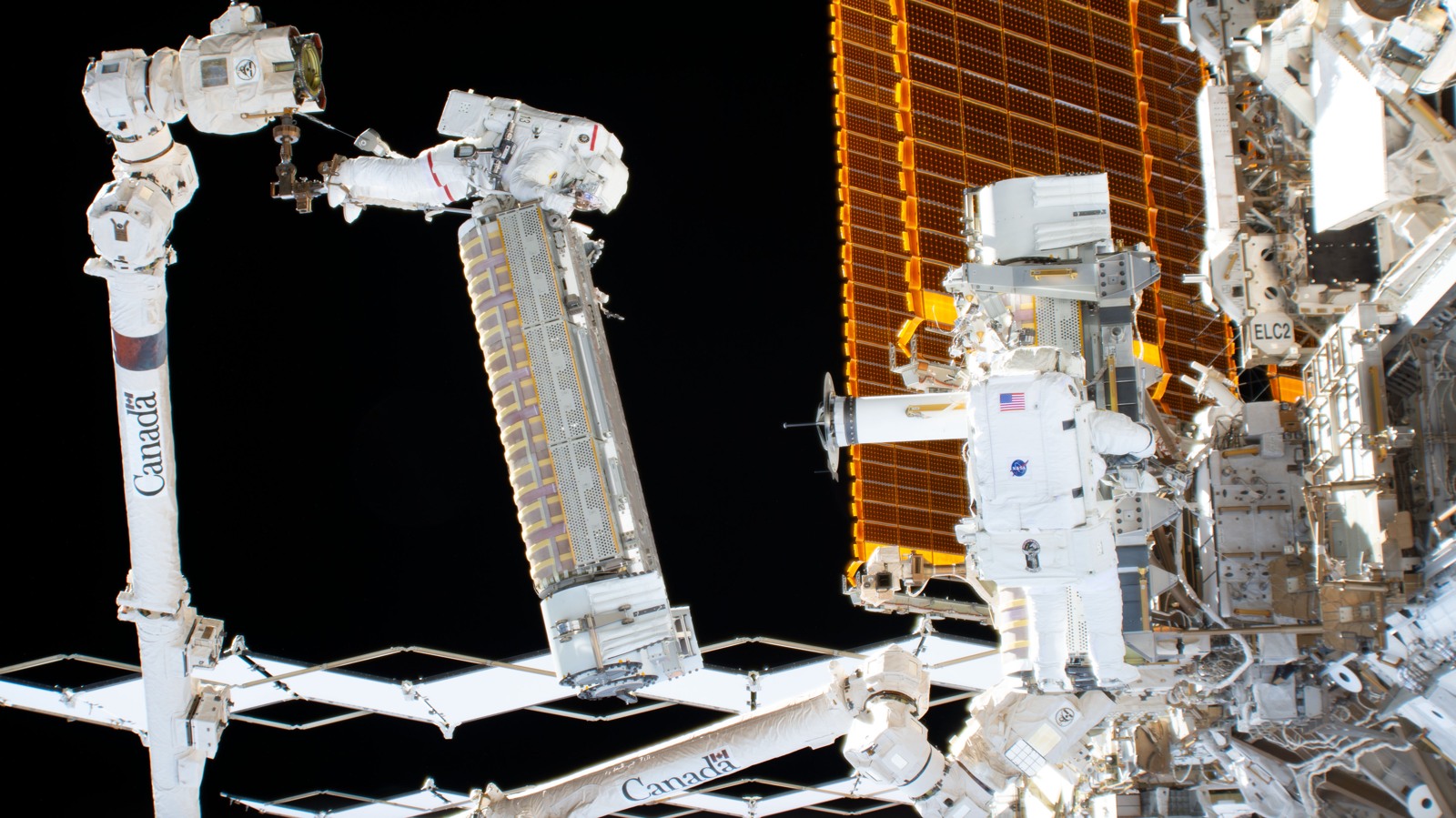
The International Space Station is extending its power capability with solar arrays that travel to orbit rolled into compact cylinders. NASA's October 15 update describes how this design has developed from a technology demonstration into an upgrade supporting research and daily operations aboard the station.
After installation, the arrays unfold rather like a mat. Their compact launch shape reduces the space required for transport, while the deployment system controls their rollout. That solves a practical engineering problem: a panel needs a large exposed surface in orbit but must fit inside a delivery vehicle first.
A station experiment tested the technology in 2017. Six of the newer arrays were installed between 2021 and 2023, supplementing the original power system. NASA says another pair travelled aboard the SpaceX CRS-35 supply mission after power projections prompted an additional order.
The agency projects that the complete eight-array upgrade will add more than 160 kilowatts for station work. That figure describes the combined upgrade, not the output of every individual panel. The original and newer arrays form parts of a larger generating and distribution system.
Electricity supports life-support equipment, communications and scientific investigations. An improved supply therefore affects what the laboratory can operate, rather than simply changing its appearance. Installation also requires careful work outside the station, as the historical spacewalk photograph illustrates.
The broader lesson is how a small demonstration can inform operational hardware. A successful rollout does not remove the need to manage ageing components, power storage and demand. It gives the station another way to maintain useful capacity while testing technology relevant to other spacecraft.