Physicists have proposed a sharper way to understand matter resembling the extremely hot fluid that filled the early universe. A study published in Physical Review Letters on 5 November calculates how fast-moving heavy quarks exchange momentum with their surroundings. The result is theoretical: it provides a new description to test against experimental measurements.
The authors are Jean F. Du Plessis of MIT and Bruno Scheihing-Hitschfeld of the University of California, Santa Barbara. Their calculations examine particles travelling close to the speed of light through plasma. They found that unusually large changes in motion cannot be described adequately by the familiar, symmetrical bell-shaped pattern often used for random disturbances.
The important difference lies in the rare events. In the calculation, a large jolt that slows a heavy quark is more likely than an equally large jolt that speeds it up. The probability pattern therefore has uneven tails. This does not mean each particle must slow down at every moment; it describes the distribution of possible changes across many interactions.
The paper derives that pattern for a plasma whose particles interact relatively weakly. The researchers also identify the same structure in an earlier calculation for strongly interacting plasma. They consequently expect it to be relevant to physical quark-gluon plasma. That expectation is a proposed connection to nature, not proof that this new prediction has already been confirmed in a detector.
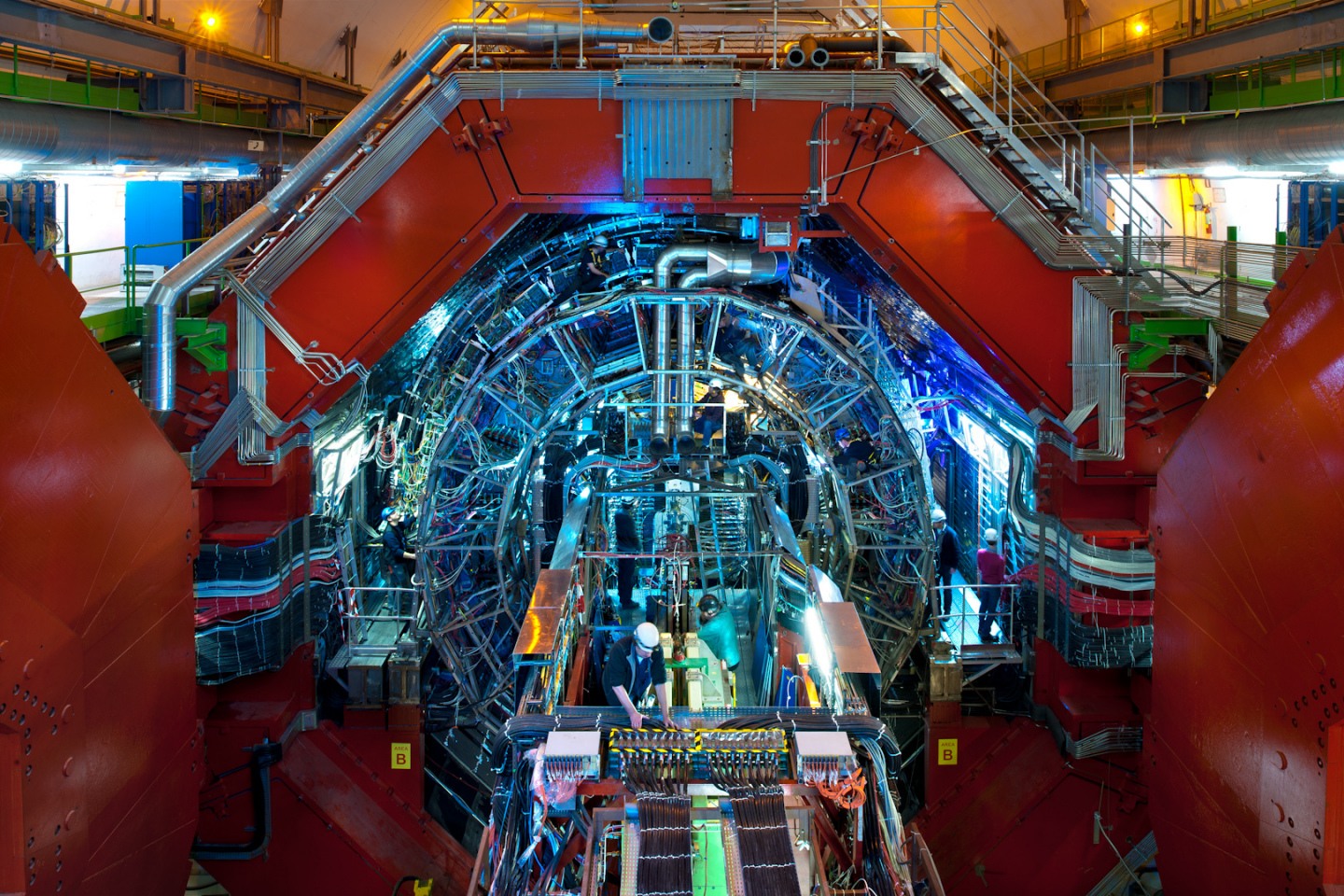
Quarks and gluons are constituents of the protons and neutrons inside atomic nuclei. CERN explains that sufficiently energetic heavy-ion collisions can briefly produce a state in which they are no longer confined in those ordinary particles. Experiments such as ALICE study this quark-gluon plasma as it expands and cools, using the particles that emerge to investigate its properties.
What it means for you. For Nigerian students and readers learning physics, the useful lesson is how research connects a calculation to something measurable. A theory can change which features scientists look for in their data, including rare events that a simpler model misses. This paper advances that reasoning; it does not announce a new energy source, a consumer invention or the recreation of the whole early universe.